When advice gets cheap, what are clients actually paying for?
AI is pushing consulting from billable hours toward outcomes. A fair look at three ways firms charge, and why experience work belongs on the scorecard.
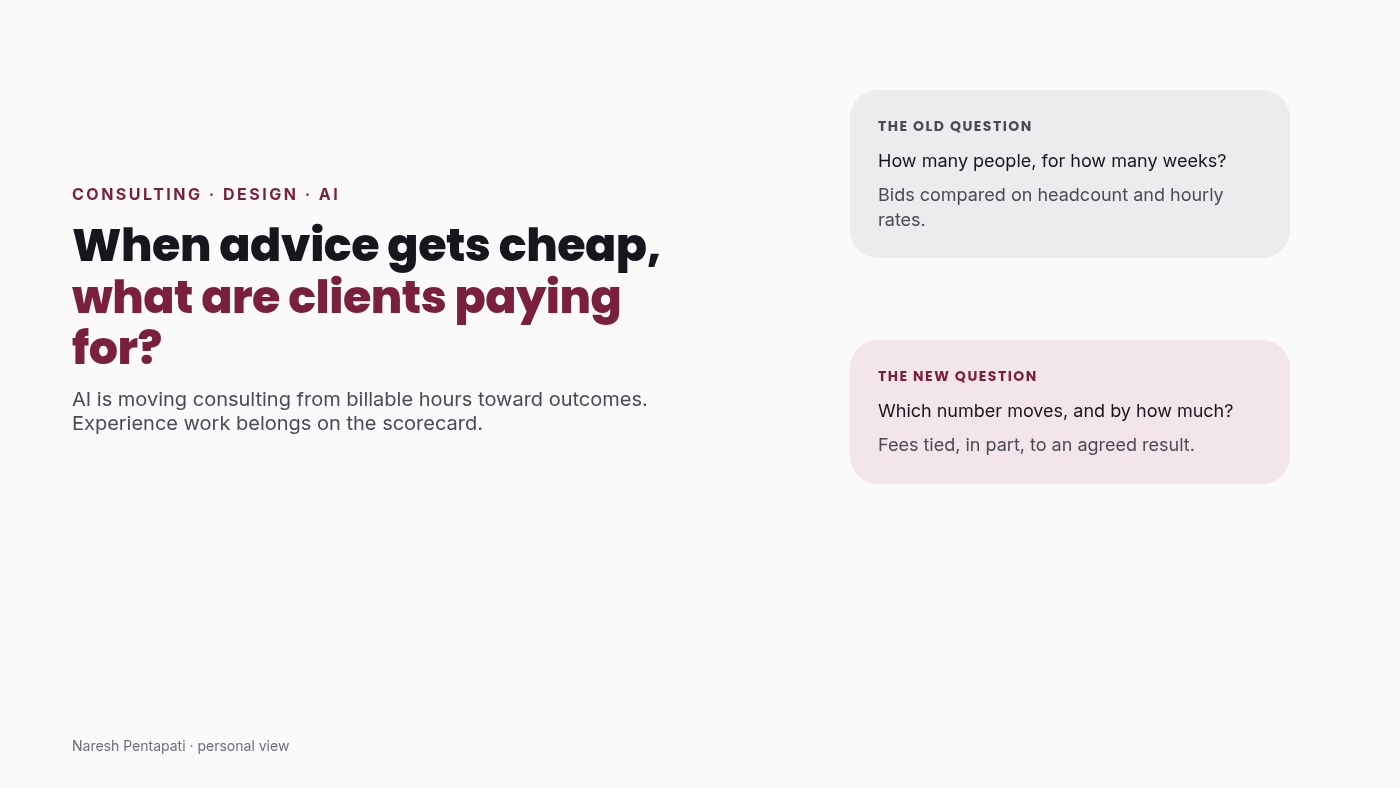
Picture a head of digital at a mid-sized retailer, sitting with three proposals for the same piece of work: fix the checkout, because too many people give up halfway. The first two proposals look familiar. They list a team, a number of weeks and a day rate for each role. The third one opens with a question instead: what is the drop-off today, and how much would it be worth to you if it fell by a third?
She has to choose by Friday, and her procurement colleague has already built a spreadsheet. It has columns for headcount and hourly rates. There is no column for the question the third firm asked.
That small scene sums up where consulting is right now. Clients increasingly want to pay for results. The tools they use to buy consulting were built for paying for time. And AI is widening the gap between the two.
What the large firms are saying
This month, CNBC ran a piece on how AI is changing consulting fees and graduate hiring. In it, Svilena Tzekova, KPMG's global head of consulting, was unusually direct: "We were making quite a lot of money by providing advice. I think that part of our business is literally nonexistent anymore." Her point was that clients can now reach, very quickly, the level of advice that once took firms days or months to produce.
She also named the practical problem. Clients say they want to pay for outcomes, but their procurement teams still compare firms on team size and hourly rates. AI adds new costs too, such as computing power and model usage fees, and she said it is very difficult to arrive at an outcome-based price that makes commercial sense. The industry, in her words, is still working out the equation.
Other firms describe the same direction. In an interview with the Wall Street Journal, republished by BCG, CEO Christoph Schweizer said that three quarters of BCG's largest AI cases now use a variable-fee arrangement, while across the wider business that share is "significantly less than a third." Last November, McKinsey told Business Insider that about a quarter of its global fees came from performance-based arrangements, measured against scorecards that include revenue or profit goals, operational measures and customer satisfaction. The same article noted that pure strategy advice was now less than 20% of McKinsey's work, with clients asking for implementation help instead.
None of this means the billable hour is disappearing tomorrow. It means the conversation about what a client is buying has changed, and that change reaches well beyond the largest firms.
Three ways to charge, compared fairly
I have bought consulting, sold it and delivered it across two decades of UX and product work. Each common model has real strengths, and each has a weak spot.
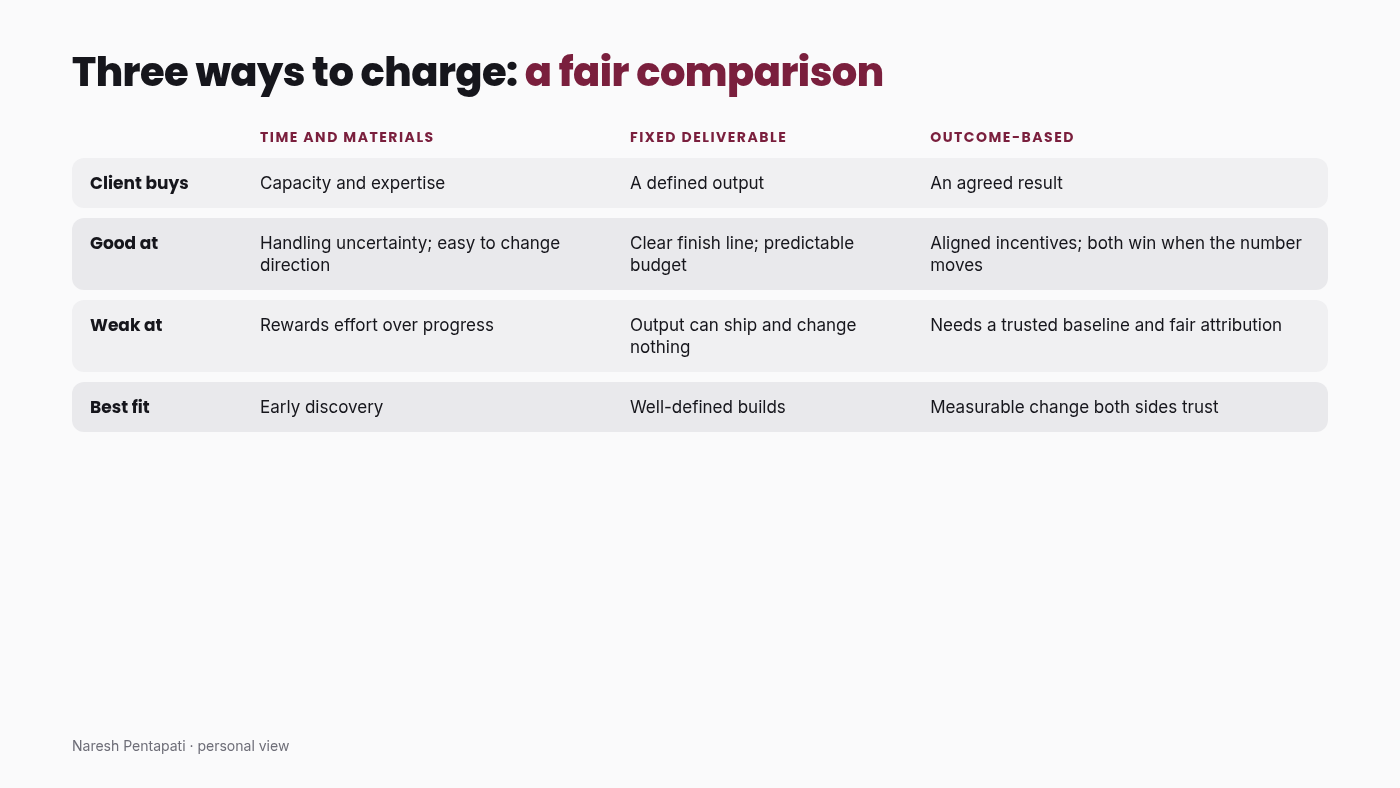
Time and materials is honest about uncertainty. When nobody yet knows the shape of the problem, paying for capacity is sensible, and it lets the client change direction without renegotiating. Its weakness is that it rewards effort rather than progress, and when AI makes some tasks much faster, an hours-based bill can start to look odd to both sides.
Fixed deliverables give everyone a clear finish line: a research report, a redesigned flow, a design system. Budgets are predictable. The risk is that the deliverable becomes the goal. A beautiful prototype can be delivered on time and still change nothing for customers.
Outcome-based pricing lines up incentives in the most direct way. Both sides win when the number moves. But it needs a trusted baseline, a measure that the work can actually influence, and agreement on what happens when something outside the team's control, like a pricing change or a market dip, moves the number too. As Tzekova said, the commercial maths is still hard.
My view is that most good engagements will blend these. Discovery may run on time and materials, a defined build on a fixed price, and a share of the fee on agreed results once both sides trust the measures.
Why experience work fits the outcome conversation
Here is the part I find most encouraging for designers and product people. When firms describe outcome scorecards, customer measures sit right next to revenue and cost. That is our home ground.
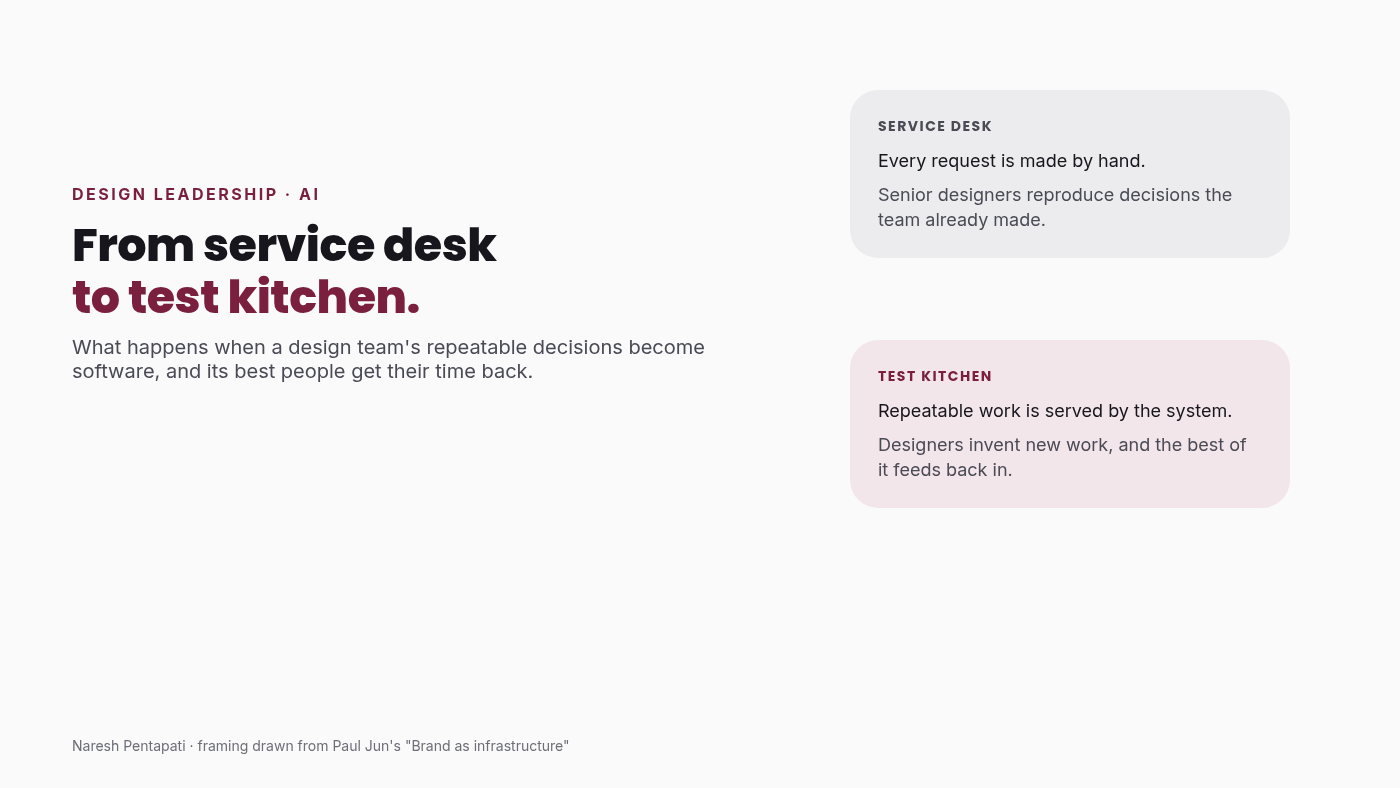
Experience work has always produced things you can measure: how many people complete a task, how long it takes, where they drop off, how many contact support, what they say afterwards. For years, many design engagements were still sold as screens and hours, because that was what the buying process could compare. As advice and first drafts become cheap, the value moves to the parts that are still hard: understanding the real problem, making good decisions under constraints, getting a change shipped, and proving it worked.
That shift asks something of us as well. A designer or consultant who wants to be paid for outcomes has to be comfortable with numbers, honest about attribution, and willing to say early when a measure is the wrong one.
A shared scorecard, step by step
When I set up work this way, the most useful thing is a scorecard both sides own from day one. A simple version looks like this.
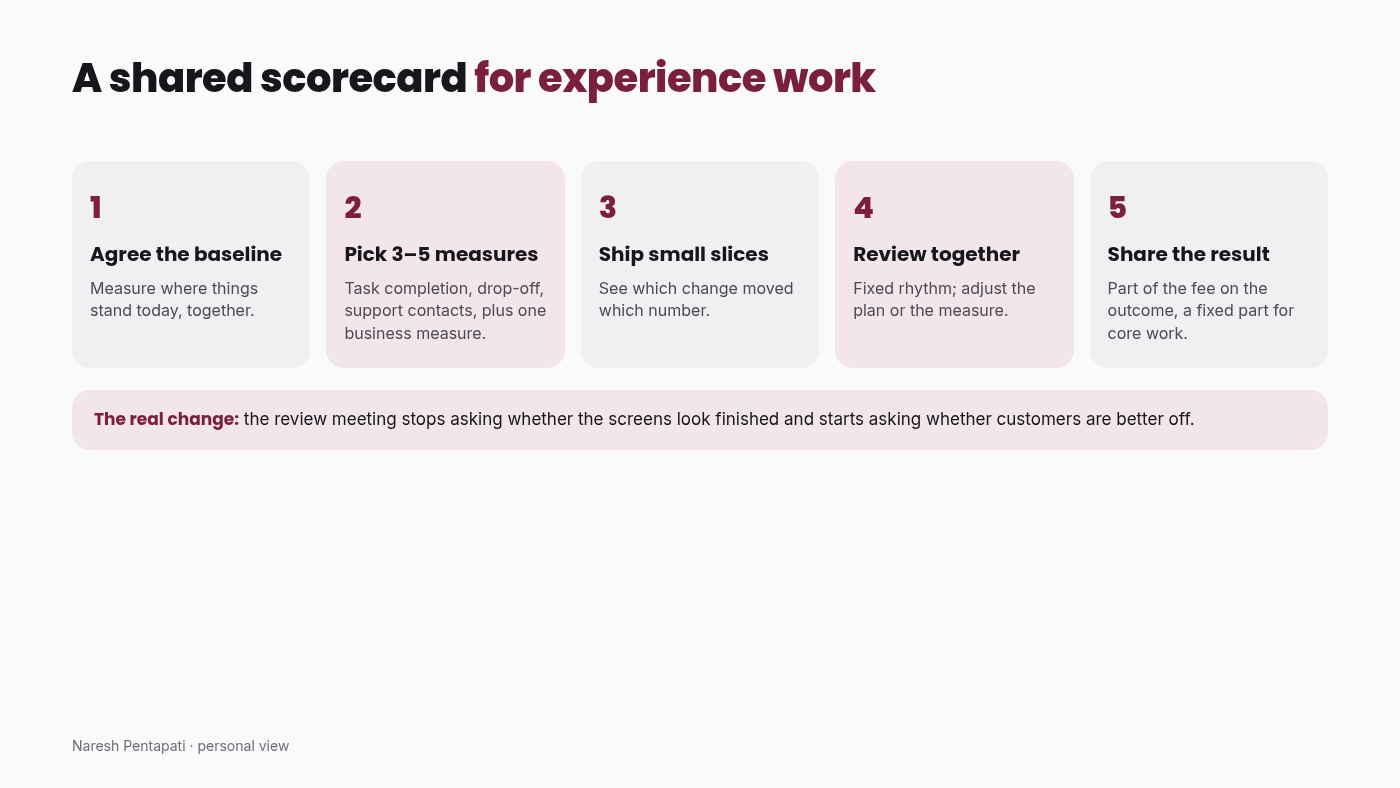
- Agree the baseline. Measure where things stand today, together, before any work starts.
- Pick three to five measures. Choose ones the work can genuinely influence, such as task completion or support contacts, plus one business measure the leadership cares about.
- Ship in small slices. Smaller releases make it easier to see which change moved which number.
- Review together. Look at the results on a fixed rhythm, and adjust the plan or the measure if the evidence says so.
- Share the result. Tie part of the fee to the agreed outcome, and keep a fixed part for the work that is needed regardless.
The scorecard does something beyond pricing. It changes the meeting. Instead of reviewing whether the screens look finished, both sides spend the hour on whether customers are better off.
What this means for buyers and for teams
For the head of digital in the opening story, the third proposal is not automatically the right one. Its question is the right one. A fair way forward could be a short discovery on time and materials to establish the baseline, followed by a build with part of the fee tied to the drop-off number. Her procurement colleague might add one more column to the spreadsheet: what result are we buying?
For design and product teams, inside companies or in consulting, the lesson is similar. Output is getting cheaper every month. Judgement, delivery and evidence are not. The teams that learn to describe their work in terms of outcomes, and to measure it honestly, will be the ones clients and leaders want in the room.
I would love to hear from people on both sides of the table. If you buy or sell experience work, which measure would you be comfortable tying a fee to, and which one would you never put on a scorecard?
Comments
Join the discussionNo comments yet. Be the first to comment.