The soundbox lesson: what India's small shops teach AI product teams about trust
A small speaker on a shop counter is one of the best pieces of experience design I know. AI products can learn a lot from it.
It is a little after seven in the evening at a tea stall near a metro station in Hyderabad. There are eight people waiting, three conversations going on at once, and a pan of milk that needs constant attention. A customer scans the QR code taped to the counter and pays. Before the shopkeeper even looks up, a small speaker announces the amount out loud. He nods, hands over the cup, and turns to the next person. Nobody unlocks a phone. Nobody squints at an SMS. The whole confirmation takes about a second.
Most of us in India have heard that voice hundreds of times without thinking about it. I have spent more than twenty years designing digital products, and I keep coming back to that little device as a lesson in what good experience design looks like when the user is busy, the stakes are real, and the screen is the wrong place for the answer.
Small businesses are now the main stage
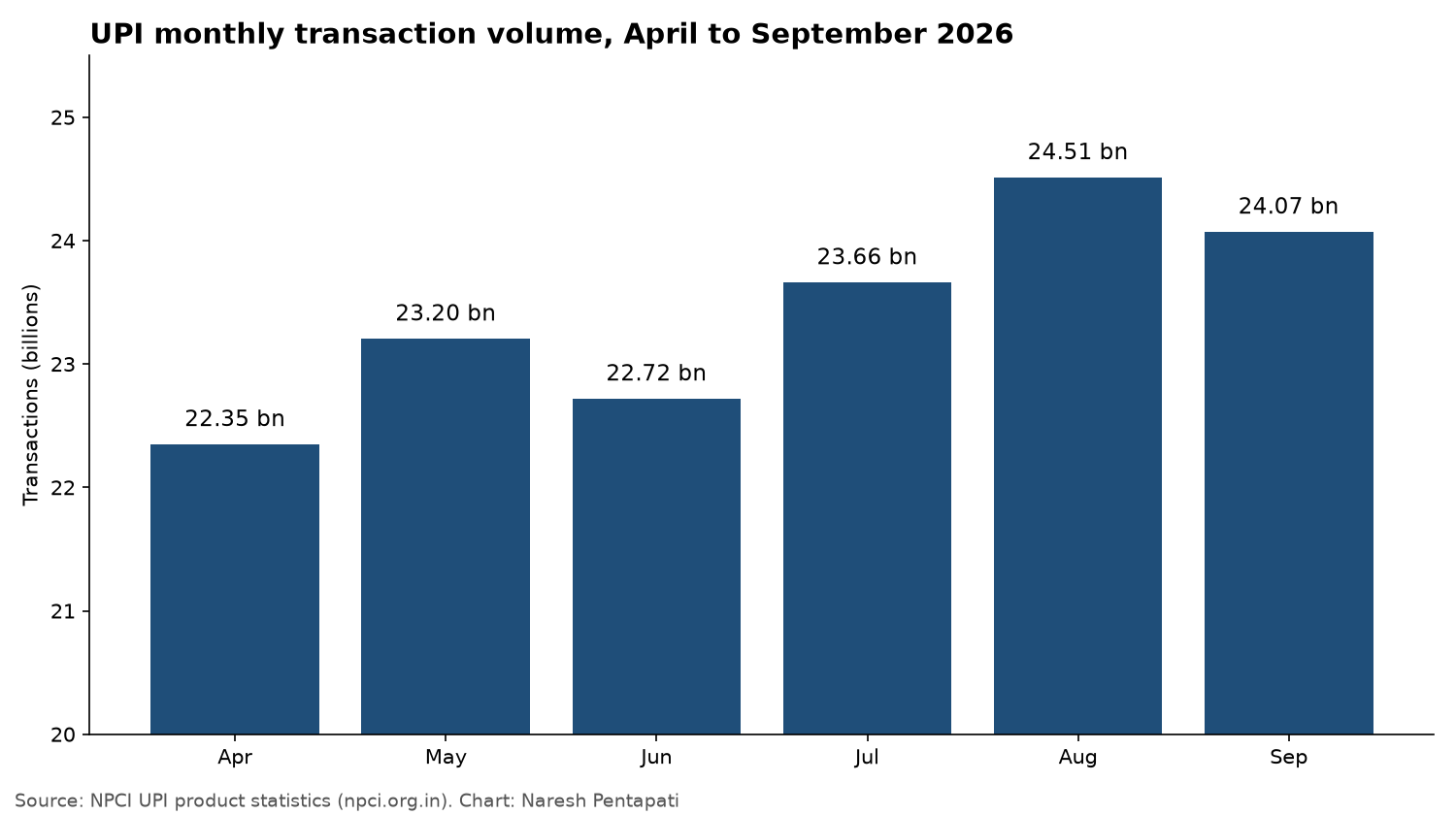
The scale behind that moment is easy to forget. According to NPCI's published UPI statistics, UPI processed about 24.07 billion transactions worth roughly ₹29.37 lakh crore in September 2026, and Business Standard reported that daily volume reached a record of about 802 million payments that month, with volumes up 22.6 percent year on year.
Counters like that tea stall are where most of us see those numbers come to life. What I find most interesting is how UPI got there. One small published survey of merchants found that about 70 percent said they first set up UPI mainly because their customers asked for it (study link). The adoption was pulled by everyday users, not pushed by a sales team. Small businesses did not wait to be convinced. They adapted because their customers had already moved.
That is a useful reminder for anyone building products right now. The most demanding users in the country are often not enterprise buyers with long procurement cycles. They are shopkeepers with a queue in front of them and no patience for software that slows them down.
Why a speaker worked where a screen struggled
Rest of World describes the soundbox as a speaker with a built-in SIM that reads out payment confirmations in English and several Indian languages, including Hindi, Tamil, Telugu, Bengali and Punjabi. Paytm introduced it in 2019, and other providers, including BharatPe, PhonePe and Google Pay, later launched their own versions. TechCrunch reported in 2024 that more than 20 million merchants were already using one of these boxes.
When I look at it as a designer, three choices stand out.
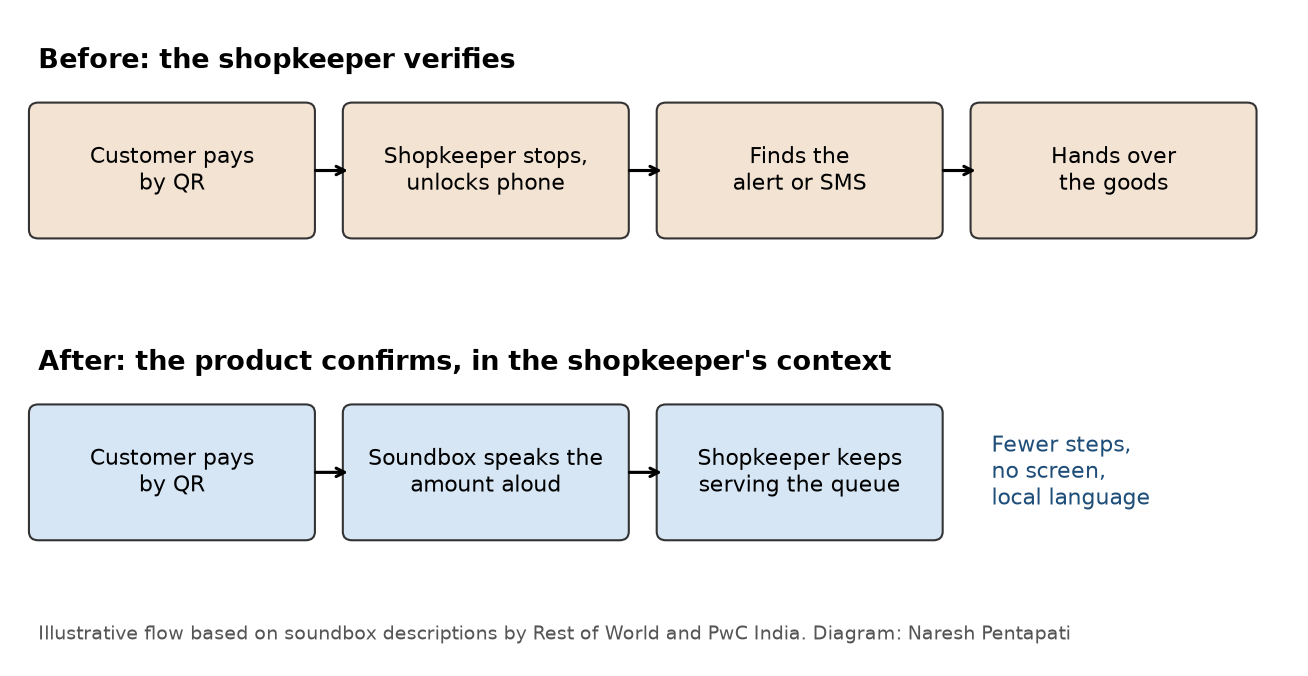
It confirms the outcome, not the process. The shopkeeper does not need to know how the payment travelled between banks. He needs one fact: did the money arrive, and how much. The device says exactly that and nothing more.
It meets the user in their context. The shop is noisy, hands are busy, and eyes are on the customer. Sound works there in a way a notification banner does not. The language options matter just as much. A confirmation you understand instantly is worth more than a detailed one you have to decode.
It removes a step instead of adding a feature. The before and after are simple.
PwC India's survey of 51 merchants found that about 92 percent felt the device was worth the investment, citing instant confirmation and the ability to confirm payments without the owner being physically present. The same survey is honest about the weak spots too. About 51 percent reported operational issues such as battery life and notifications being skipped during peak hours, and many raised concerns about fraud, like fake QR codes pasted over real ones. Good design does not make a product perfect. It makes the core promise dependable enough that people build their routines around it, and it shows clearly where the next round of work is needed.
What this means for AI products
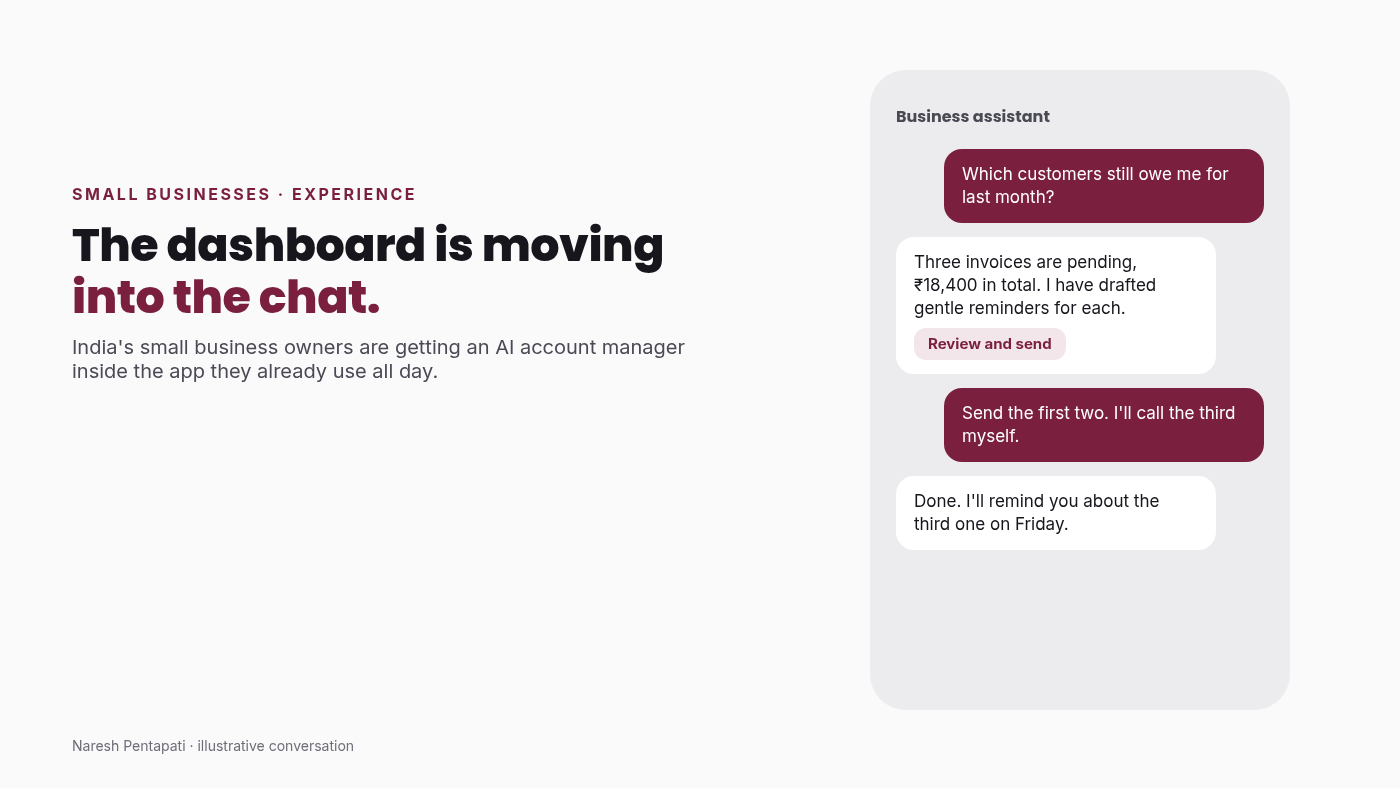
Right now a lot of AI products are being designed for people sitting at a desk, reading long outputs and clicking through options. That is a valid use case, but it is a narrow one. In my view, the bigger opportunity in India sits with small businesses, field workers and first-time digital users. For them, the soundbox sets the bar.
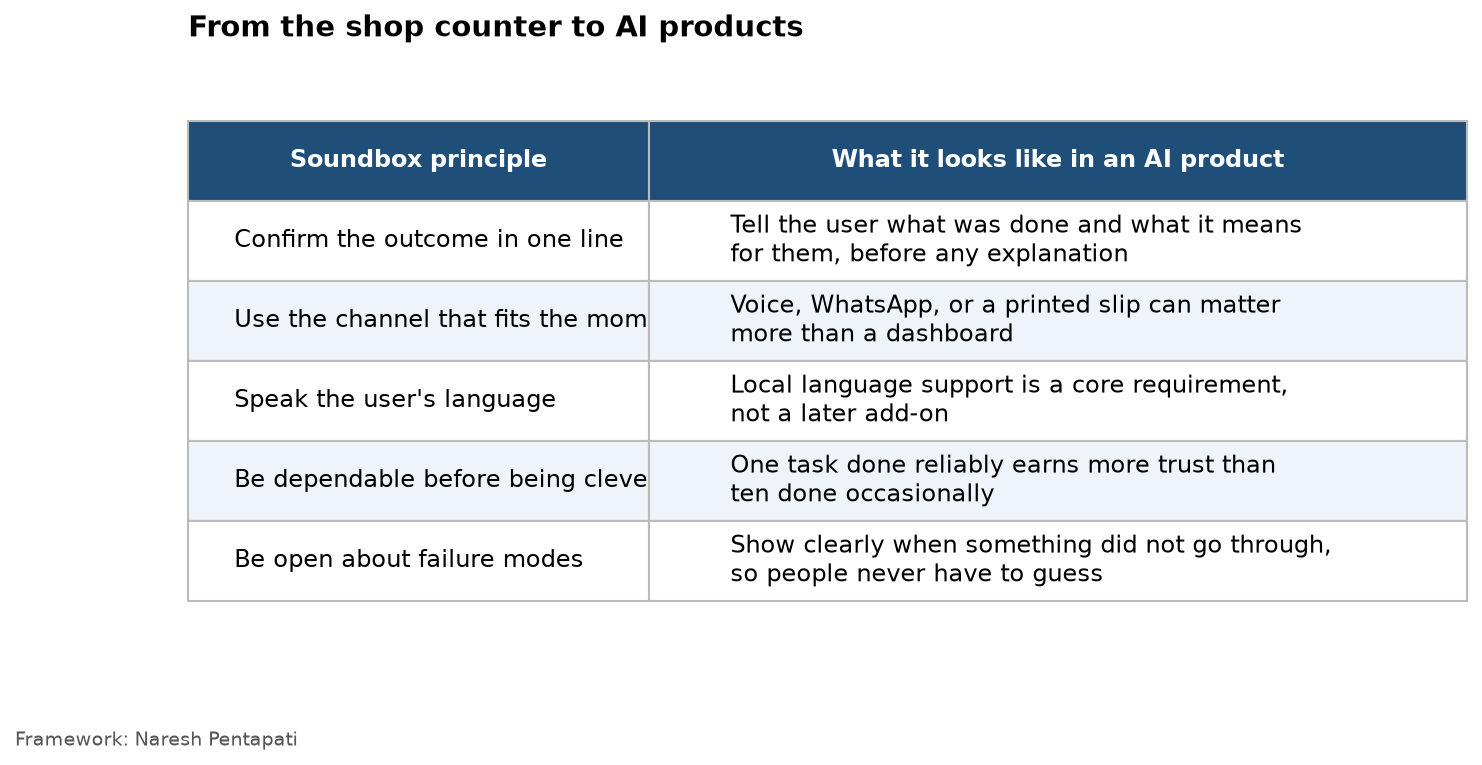
Here is how I would translate it into practice for a product team building with AI today:
| Soundbox principle | What it looks like in an AI product |
|---|---|
| Confirm the outcome in one line | Tell the user what was done and what it means for them, before any explanation |
| Use the channel that fits the moment | Voice, WhatsApp, or a printed slip can matter more than a dashboard |
| Speak the user's language | Local language support is a core requirement, not a later add-on |
| Be dependable before being clever | One task done reliably earns more trust than ten done occasionally |
| Be open about failure modes | Show clearly when something did not go through, so people never have to guess |
I have seen the same pattern in enterprise work. Teams spend months refining an AI feature's reasoning and very little time on the moment where a person has to trust the result and act on it. Yet that moment decides whether the feature is used again. A shopkeeper who hears "₹40 received" trusts the system because it has been right thousands of times in a row, in a form he can absorb without stopping.
The leadership angle
For design and product leaders, I think the lesson is about where we point our teams. It is tempting to measure AI products by how much they can do. I would rather measure them by how little effort they ask from the person using them at the busiest point in their day.
That requires spending real time with users who are not like us. Sit at a counter for an hour. Watch how a pharmacy owner, a tailor or a vegetable vendor actually runs their day. Notice what they ignore and what they act on instantly. Those observations will shape an AI product more than another round of prompt tuning.
India's small businesses have quietly become some of the most sophisticated digital users in the world, not because they love technology, but because they adopt whatever helps them serve the next customer faster. If we design AI for them with the same care that went into a small speaker on the counter, I believe we will build products that make the whole economy more resilient, and that hold up far beyond India too.
The best confirmation I have ever designed for was never a screen. It was a voice saying the amount out loud, at exactly the right moment, in the right language. That is the standard I want AI products to reach.
Naresh Pentapati is a design and product leader with more than 20 years in UX, product management and AI-enabled design. He writes about design, product, consulting and AI.
Comments
Join the discussionNo comments yet. Be the first to comment.